Link to Source: GitHub, Online Web Application
Authors: Giovanni Baj, Nicola Ciocca, Pooya Mohammadi Kazaj, Xuan Ma, Benedikt Bernhard, Jinghui Li, Jonathan Schütze, George C. M. Siontis, Stephan Windecker, Shihua Zhao, Raymond Y. Kwong, Isaac Shiri, Christoph Gräni
Summary: AiMyoCAST is a research decision support tool that combines clinical, electrocardiographic and imaging data to estimate an individual patient’s risk of major heart events at one to three years after myocarditis, and shows which factors drove the estimate.
AiMyoCAST, pronounced “AI-myo-cast”, stands for Artificial Intelligence for Myocarditis Outcome Forecast. It is a clinical decision support platform for individualized prognostic assessment in patients with myocarditis, an inflammation of the heart muscle. Built on a machine learning framework, it quantifies the probability of major adverse cardiovascular events and translates multidimensional patient data into interpretable, individualized risk estimates intended to support clinical decision-making.
The model was developed and internally validated in a cohort from Boston, United States, and then externally tested in geographically and clinically distinct cohorts from Bern, Switzerland, and Beijing, China. It integrates clinical characteristics, electrocardiographic findings and parameters from several cardiovascular imaging methods. To make its reasoning transparent, it applies an explainable artificial intelligence method known as survSHAP, which quantifies how much each individual predictor contributed to a given risk estimate. Across these heterogeneous international populations, which differed in both diagnostic criteria and baseline risk profiles, the model showed robust discrimination and generalizability.
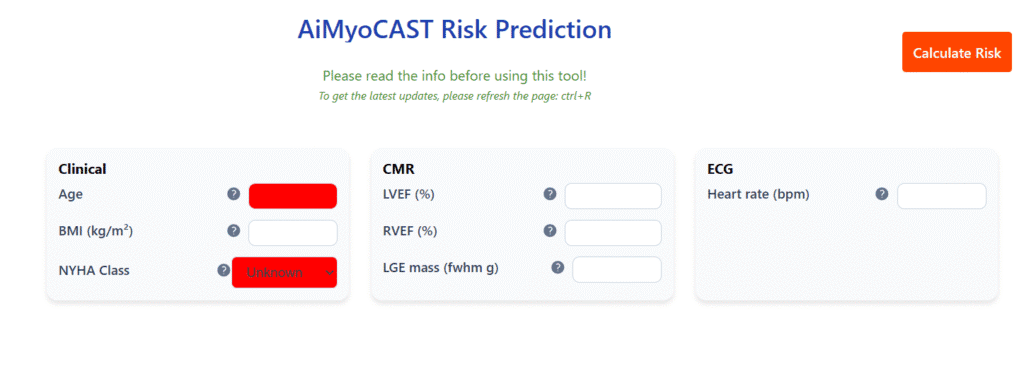
Users are asked to complete as many of the input fields as possible. Numerical fields should be left empty when a measurement is unavailable, and categorical fields should be left as “Unknown”. The platform is designed to handle missing values, including cases in which every input is missing, because the underlying models require a complete data set and therefore fill any gaps by imputation, that is, by estimating the missing values from patterns learned during training. Performance nonetheless depends on how complete and accurate the entered data are. If a feature appears in the results that was not entered, it was imputed in this way. Entered values should also be checked for consistency with a diagnosis of myocarditis, since the platform will return an output regardless of whether the data are clinically appropriate.
For each event, the output reports the predicted risk at several time points, from one to three years, together with a corresponding risk class derived from the risk distribution of the training cohort. Full methodological detail is given in the accompanying paper. The platform was built by the AI-CVM lab team together with international collaborators, and is intended for research purposes only; it has not been approved for clinical use.
Baj G, Ciocca N, Mohammadi Kazaj P, Ma X, Bernhard B, Li J, Schütze J, Siontis GCM, Windecker S, Zhao S, Kwong RY, Shiri I, Gräni C. Artificial Intelligence-Driven Risk Prediction for Major Adverse Cardiovascular Events in Myocarditis: A Multinational Model Development, Validation, and Testing Study. Under review, 2026.