Before an artificial intelligence (AI) tool can be used in routine radiology, it has to be authorized by regulators: the Conformité Européenne (CE) mark in Europe, and clearance by the Food and Drug Administration (FDA) in the United States. Most products eventually seek both, but the two systems assess devices differently, and little is known about how long a product waits between its first and its second authorization. Earlier comparisons looked mainly at where a device was approved first, under the former European Medical Device Directive. Whether that pattern still holds under the stricter Medical Device Regulation (MDR), which became applicable in May 2021, had not been systematically quantified.
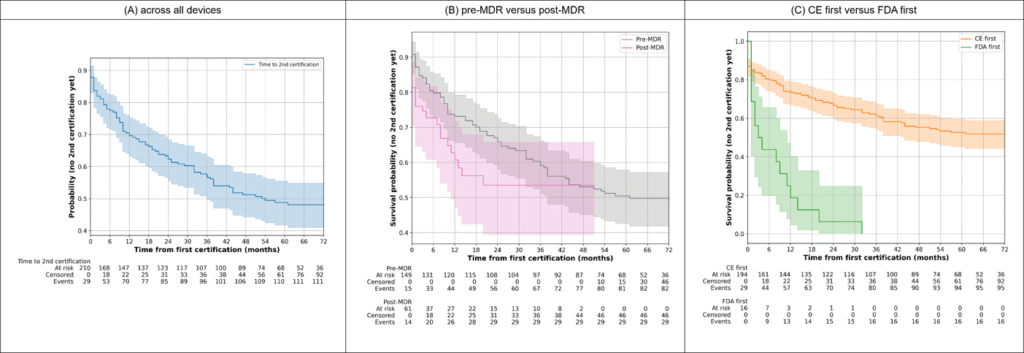
This study analyzed 239 AI-enabled radiology devices carrying CE marking, drawn from a publicly available European database (Health AI Register) and cross-checked against FDA records. Of these, 128 (53.6%) carried CE marking only, 95 (39.7%) were CE marked and later cleared by the FDA, and 16 (6.7%) were cleared by the FDA before receiving CE marking. Time to second authorization was examined using Kaplan-Meier methods and Cox proportional hazards models, alongside device characteristics such as imaging modality, European risk class, and the availability of peer-reviewed evidence.
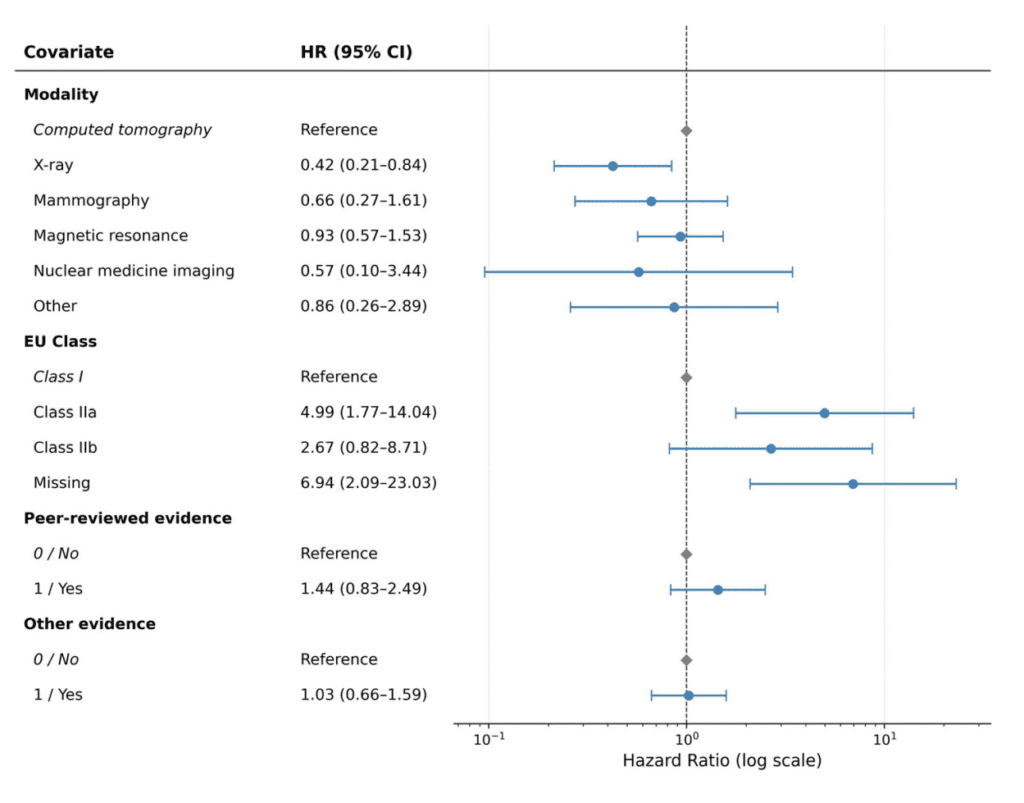
The gap between the two authorizations was both long and asymmetric. Half of the devices had still not obtained a second authorization by 54 months, and 70% remained singly authorized one year after their first approval. Among devices that did reach both markets, those starting in Europe waited a median of 17.5 months (interquartile range, IQR, 8.0-35.5) for FDA clearance, compared with 3.5 months (IQR, 1.0-11.3) for devices starting in the United States (p < 0.001). Timing did not differ significantly before and after the MDR became applicable (p = 0.17). Software for interpreting standard radiographs took longer to reach a second authorization than computed tomography software (hazard ratio, HR, 0.42; 95% confidence interval, CI, 0.21-0.84; p = 0.01), while devices in European risk Class IIa reached it faster (HR 4.99; 95% CI 1.77-14.04; p < 0.01). Publicly available peer-reviewed evidence, present for only about a third of devices, showed a faster but uncertain association (HR 1.44; 95% CI 0.83-2.49; p = 0.19).