Links: GitHub, Web App, Web App, Paper
Authors: Giovanni Baj, Nicola Ciocca, Pooya Mohammadi Kazaj, Xuan Ma, Annina A. Studer Bruengger, Simon F. Stämpfli, Niklas F. Ehl, Sarah Hugelshofer, Otmar Pfister, Joëlle Lehmann, Christoph Ryffel, Lukas Hunziker, Michael Poledniczek, Andreas Kammerlander, George C. M. Siontis, Stephan Windecker, Moritz J. Hundertmark, Christian Nitsche, Isaac Shiri, Christoph Gräni
Summary: This study builds a machine learning model that estimates the risk of death or heart failure hospitalization in people with transthyretin amyloid cardiomyopathy, trained on 850 patients from amyloidosis referral centers in Switzerland and Austria, and shows it separates higher from lower risk patients more reliably than the staging systems clinics currently use.
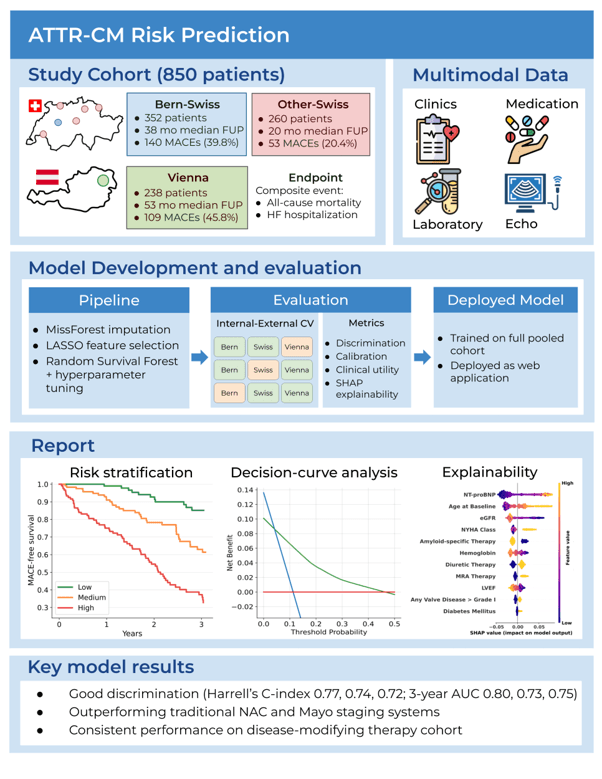
IMPORTANCE Transthyretin cardiac amyloidosis (ATTR-CM) is associated with poor prognosis and significant morbidity and mortality, yet existing staging systems have limited ability to accurately predict outcomes in contemporary patient populations.
OBJECTIVE To develop and validate a machine learning (ML)–based prognostic model for patients with ATTR-CM.
DESIGN, SETTING, AND PARTICIPANTS This multicenter cohort study, including specialized referral centers for cardiac amyloidosis, used data from patients with confirmed ATTR-CM in the Swiss Cardiac Amyloidosis Registry (February 2018 to November 2025) and the Cardiac Amyloidosis Registry of the Medical University of Vienna (July 2014 to February 2025). A random survival forest model was developed and evaluated through internal-external cross-validation, with each center iteratively held out for validation. The model was compared with the National Amyloidosis Centre and Mayo Clinic staging systems. Data analysis was conducted from December 2025 to February 2026.
EXPOSURE Clinical, demographic, medication, laboratory, and echocardiographic variables were used to train an ML-based time-to-event prediction model.
MAIN OUTCOMES AND MEASURES The primary outcome was defined as a composite event of all-cause mortality and hospitalization for heart failure.
RESULTS A total of 850 patients (median [IQR] age, 79 [74-83] years; 750 [88.2%] male) were included across 3 cohorts (from Bern, Switzerland [Bern-Swiss cohort], n = 352; the other centers from Switzerland combined [Other-Swiss cohort], n = 260; and Vienna, Austria [Vienna cohort], n = 238). The random survival forest model demonstrated good discrimination across all held-out cohorts, with Harrell concordance indices of 0.74 (95% CI, 0.69-0.78), 0.77 (95% CI, 0.69-0.83), and 0.72 (95% CI, 0.67-0.77) for the Bern-Swiss, Other-Swiss, and Vienna cohorts, respectively, and 3-year area under the curve (AUC) of 0.73 (95% CI, 0.66-0.80), 0.80 (95% CI, 0.70-0.88), and 0.75 (95% CI, 0.67-0.83), respectively. The model showed improved discrimination compared with the National Amyloidosis Centre and Mayo Clinic staging systems, with Harrell concordance indices 2% to 10% higher and 3-year AUC improvements ranging from 3% to 19% across cohorts and scoring systems. Calibration was generally acceptable across cohorts and time points. Model performance remained satisfactory in the subgroup of patients receiving disease-modifying therapy. Explainability analyses identified clinically plausible drivers of risk.
CONCLUSIONS AND RELEVANCE An ML-based time-to-event prediction model demonstrated promising predictive performance and showed improved discrimination compared with established staging systems in patients with ATTR-CM, supporting its potential for individualized prognostication.