Artificial Intelligence in Valvular Heart Disease: Innovations and Future Directions

Publication

Link to Source: https://www.jacc.org/doi/10.1016/j.jcin.2025.08.031

Authors: Annette Maznyczka, Rutger-Jan Nuis, Isaac Shiri, Julien Ternacle, Philippe Garot, Mark M.P. van den Dorpel, Arif A. Khokhar, Raffaele De Lucia, Michele Orini, Shelby Kutty, Julia Grapsa, Christoph Gräni, Ambarish Pandey, Taylor Becker, Kevin O’Gallagher, Peter Mortier, Lakshmi Prasad Dasi, Klaus Fuglsang Kofoed, Sandy Engelhardt, Patric Biaggi, Faraz S. Ahmad, Dee Dee Wang, Lionel Leroux, Thomas Modine, Stephan Windecker, Rebecca T. Hahn, Nicolas M. Van Mieghem, and Ole De Backer

Summary: This review examines how artificial intelligence can transform valvular heart disease management by integrating multimodal data for enhanced diagnosis, procedural optimization, and personalized treatment strategies, while addressing critical challenges including validation requirements, algorithmic bias, and transparency concerns that must be resolved for successful clinical implementation.
Abstract

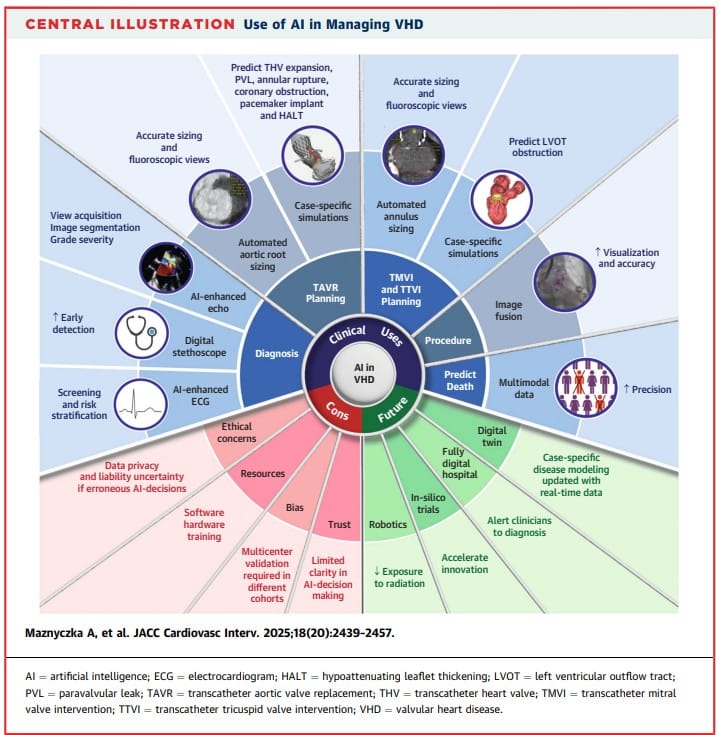
Managing valvular heart disease (VHD) requires integrating multimodal data, including demographics, symptoms, biomarkers, electrocardiogram findings, and imaging studies. However, the capacity and processing power of the human mind are limited, particularly in the current era where vast quantities of complex data require rapid processing. Integrating artificial intelligence (AI) into the management of VHD offers an opportunity to enhance diagnostic accuracy, streamline clinical workflows, optimize procedural strategies, and predict outcomes and disease progression. Subsets of AI such as machine learning and deep learning algorithms can uncover the unseen data from routine investigations (eg, electrocardiograms, echocardiography, and computed tomography), providing robust and accurate risk prediction tools to inform personalized treatment strategies. Intraprocedurally, AI-based enhancements in imaging guidance can be leveraged to improve procedural safety and success. Digital twin technology can allow case-specific disease modelling, such as simulating valve designs and predicting adverse events, fostering precision medicine. By using the full potential of AI, clinicians can provide a comprehensive, personalized management strategy for VHD patients, ultimately enhancing clinical outcomes. However, models based on AI algorithms require rigorous validation across multiple centers to ensure their reliability. Concerns about bias, data privacy, and limited transparency challenge the application of AI decision-making to digital health care. This review discusses the applications of AI in the management of patients with VHD, highlights the future directions of AI technologies, and considers the challenges of integrating AI into clinical practice.