IEEE Bruce Hasegawa Young Investigator Medical Imaging Science Award 2025

Dr. Isaac Shiri won the IEEE Bruce Hasegawa Young Investigator Award in Medical Imaging Science, which was presented at the IEEE Medical Imaging Conference in Yokohama, Japan, on 4–8 November 2025.
Automated Intravascular Ultrasound Image Processing and Quantification of Coronary Artery anomalies: The AIVUS-CAA Software
This study introduces an executable, low-code software that automatically segments lumen contours and identifies cardiac phases in intravascular ultrasound images from patients with intramural coronary artery anomalies, turning what is normally a slow, rare, and reader-dependent analysis into a fast and reproducible workflow that holds up under both rest and stress conditions.
AI Heart Anomaly Detection Featured in The Germany Eye

The article highlights how our pioneering tool for detecting and classifying anomalous aortic origin of coronary arteries via CT scans, developed at University of Bern.
AI-CVM Research Featured in 20 Minuten

Our recent work on AI-based detection and classification of anomalous aortic origin of coronary arteries (AAOCA) using coronary CT angiography has been featured in 20 Minuten.
Young Investigator Award in Valvular Heart Disease at ESC 2024
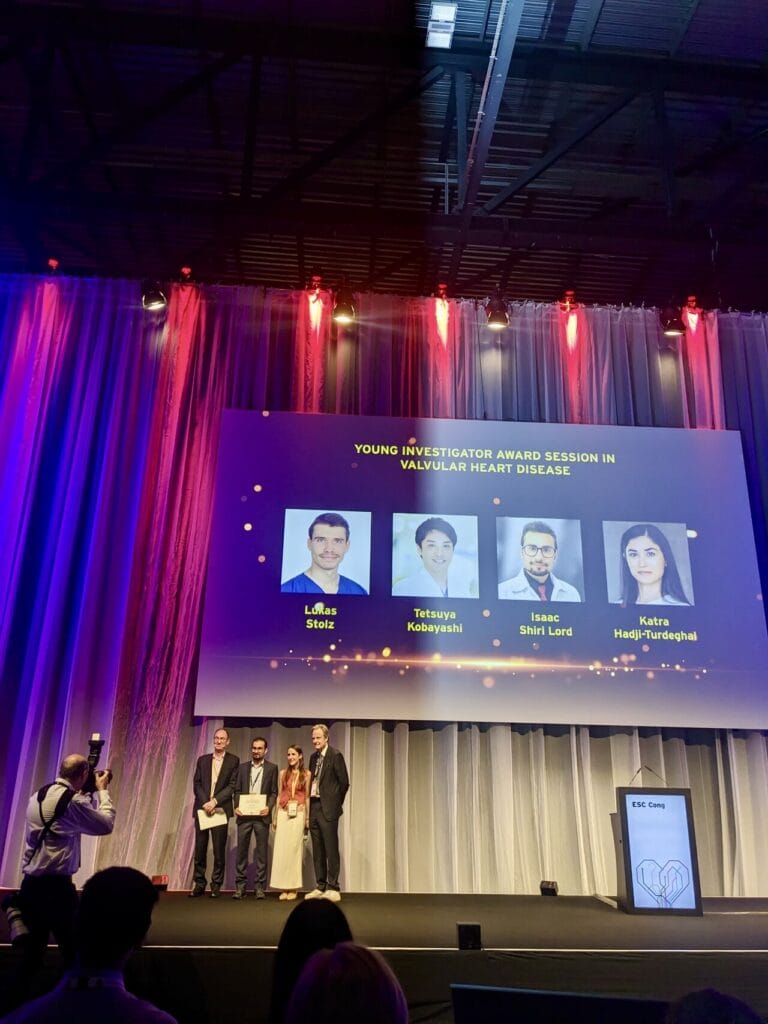
Isaac has received the Young Investigator Award in Valvular Heart Disease at the European Society of Cardiology Congress (ESC 2024) for developing TAVI-ALPURA.
CVRC 2025 Prize for Best Flash Presentation
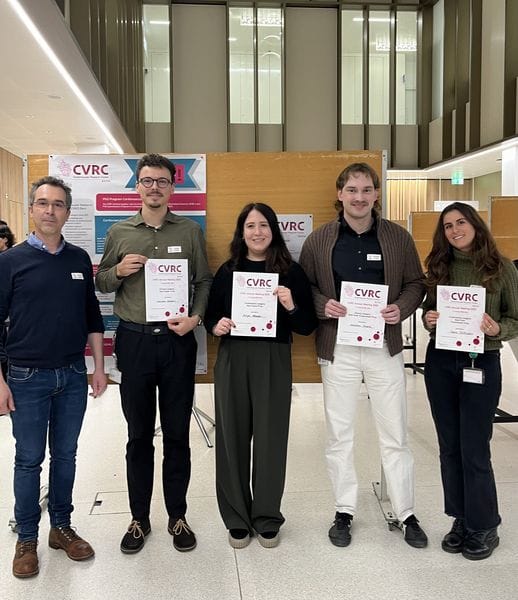
Anselm has been awarded the Cardiovascular Research Cluster Bern (CVRC) 2025 Prize for Best Flash Presentation in the Clinical Category for his work on AIVUS-CAA
Artificial Intelligence in Valvular Heart Disease: Innovations and Future Directions
This review examines how artificial intelligence can transform valvular heart disease management by integrating multimodal data for enhanced diagnosis, procedural optimization, and personalized treatment strategies, while addressing critical challenges including validation requirements, algorithmic bias, and transparency concerns that must be resolved for successful clinical implementation.
Multimodal Machine Learning-Based Technical Failure Prediction in Patients Undergoing Transcatheter Aortic Valve Replacement

This study builds and validates machine learning models that draw on 184 clinical, imaging, and procedural variables from nearly 3,000 consecutive TAVR patients to anticipate VARC-3 technical failure before it happens, showing that cardiac and vascular complications can be predicted with moderate-to-high accuracy.
Myocardial Perfusion SPECT Radiomic Features Reproducibility
This study demonstrated that radiomic features extracted from cardiac SPECT images are highly sensitive to reconstruction parameters, emphasizing the need for standardized imaging protocols to ensure reliable clinical applications in coronary artery disease assessment.
Generalizability of FDA-Approved AI-Enabled Medical Devices
This cross-sectional analysis of 903 FDA-approved AI medical devices revealed significant gaps in clinical validation and generalizability reporting, raising concerns about their performance across diverse patient populations and real-world settings.