Background: Appropriate risk prediction is essential to inform long-term management in patients with symptomatic severe aortic stenosis after transcatheter aortic valve implantation (TAVI). We aimed to develop multimodal artificial intelligence (AI)-based models to predict long-term mortality of patients with symptomatic severe aortic stenosis following TAVI.
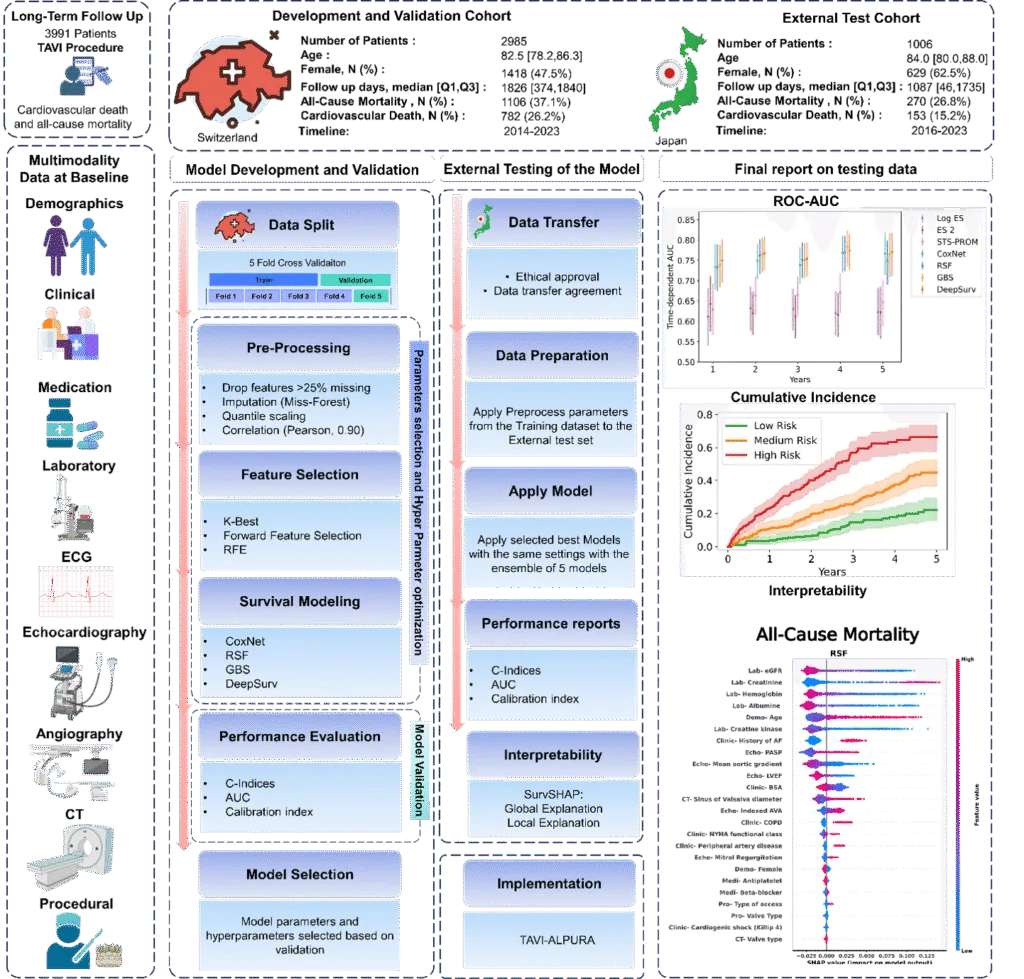
Methods: In this multicentre development, validation, and testing study, multimodal data (including clinical assessments, laboratory values, electrocardiograms, echocardiograms, cardiac catheterisation results, CT scans, and procedural parameters) were collected from two tertiary hospitals: one located in Switzerland (centre 1) and the other located in Japan (centre 2). The study cohort comprised consecutive patients undergoing TAVI for symptomatic severe aortic stenosis. The endpoints were all-cause mortality (including death from any cause) and cardiovascular death (including cardiovascular-specific causes, intraprocedural death, sudden death, or death of unknown cause). Clinical follow-up data (up to a median of approximately 5 years after the procedure) were obtained by standardised interviews, documentation from referring physicians, and hospital discharge summaries at each participating site. Four AI models per outcome were developed and internally validated using data from centre 1 through a structured, standardised pipeline involving preprocessing, feature selection, and time-to-event survival modelling to predict all-cause and cardiovascular death. Data from centre 2 was used for external testing. Model performance was assessed by using discrimination and calibration metrics (including Harrell’s concordance index [C-index], time-dependent area under the curve [AUC], and the integrated calibration index). Performance metrics were compared against conventional surgical risk scores (Society of Thoracic Surgeons Predicted Risk of Mortality [STS-PROM], European System for Cardiac Operative Risk Evaluation [EuroSCORE] II, and Logistic EuroScore), which were assessed using a Cox proportional hazards model. Explainability analyses were conducted for the selected models to enhance clinical transparency.
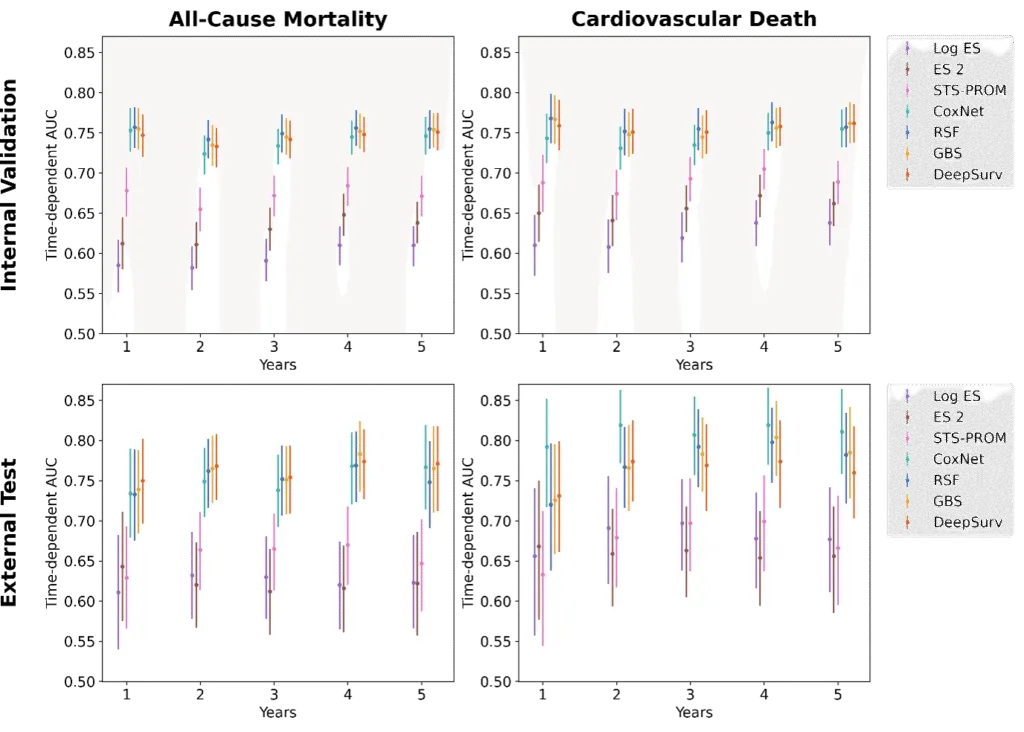
Findings: Between January 3, 2014, and June 30, 2023, 3991 patients who underwent TAVI with available pre-procedural and intraprocedural multimodal data were included from the two centres. 2985 patients from centre 1 were included in the cohort for model development and validation; 1418 (47·5%) of these patients were female, 1567 (52·5%) were male, median age was 82·5 years (IQR 78·2–86·3), and the median STS-PROM score was 3·5 (2·3–5·5). The external test set comprised 1006 patients from centre 2; this cohort had a higher prevalence of female patients (629 [62·5%]), and the patients had a lower comorbidity burden but were older (median age 84·0 years (IQR 80·0–88·0), with a higher median STS-PROM score (4·8 [3·4–7·2]. For both outcomes, AI-based models consistently outperformed conventional surgical risk scores for long-term mortality prediction, with an approximately 10–15% increase in the average 5-year AUC. In the external test set, the best performance for predicting all-cause mortality was attained with the Random Survival Forest AI model, with a Harrell’s C-index of 0·712 (95% CI 0·679–0·742). The highest performance for predicting cardiovascular death was attained by the CoxNet model, which reached a C-index of 0·776 (0·735–0·811) in the external test set.
Interpretation: Our explainable, multimodal AI-based model for predicting long-term outcomes in the TAVI population substantially outperformed conventional risk scores. The model showed robust generalisability across diverse TAVI populations and clinical settings, supporting accurate risk stratification that could potentially guide patient management.