AI-based detection and classification of anomalous aortic origin of coronary arteries using coronary CT angiography images

Publication

DOI: https://doi.org/10.1038/s41467-025-58362-9

Authors: Isaac Shiri, Giovanni Baj, Pooya Mohammadi Kazaj, Matthias R. Bigler, Anselm W. Stark, Waldo Valenzuela, Ryota Kakizaki, Matthias Siepe, Stephan Windecker, Lorenz Räber, Andreas A. Giannopoulos, George C. M. Siontis, Ronny R. Buechel, Christoph Gräni

Summary: This study developed a fully automated AI system that detects anomalous coronary artery origins in CT scans with over 99% accuracy, classifies their anatomical risk, and can alert clinicians to potentially life-threatening cases that might otherwise be missed.
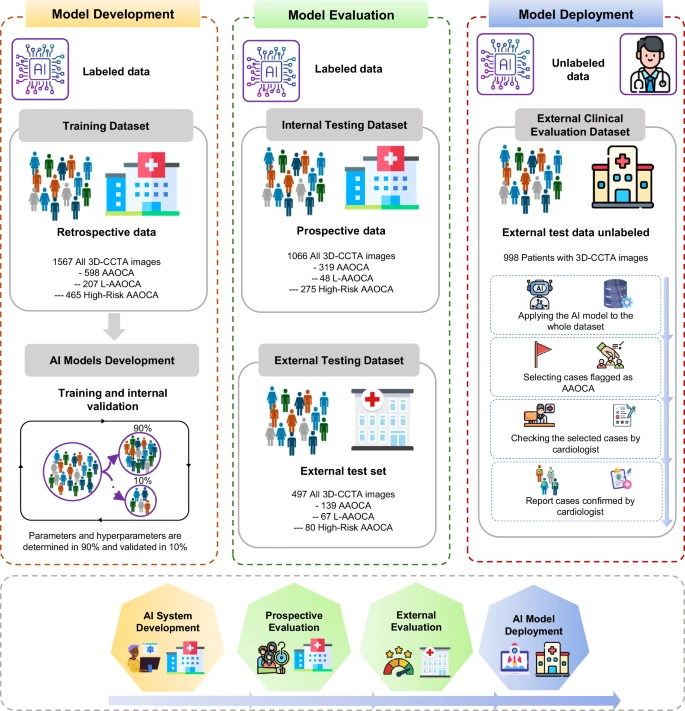
The model was developed using a retrospective dataset from the training and internal validation dataset and tested on a prospective cohort of the internal testing dataset from the same center. Models were then externally validated (external testing dataset). We finally simulated a real-world scenario using an unlabeled dataset (external clinical evaluation dataset). AAOCA Anomalous Aortic Origin of the Coronary Artery, CCTA coronary CT angiography, L-AAOCA left AAOCA, R-AAOCA right AAOCA.

Anomalous aortic origin of the coronary artery (AAOCA) is a rare cardiac condition that can lead to ischemia or sudden cardiac death, yet it is often overlooked or falsely classified in routine coronary CT angiography (CCTA). Here, we developed, validated, externally tested, and clinically evaluated a fully automated artificial intelligence (AI)-based tool for detecting and classifying AAOCA in 3D-CCTA images. The discriminatory performance of the different models achieved an AUC ≥ 0.99, with sensitivity and specificity ranging 0.95-0.99 across all internal and external testing datasets. Here, we present an AI-based model that enables fully automated and accurate detection and classification of AAOCA, with the potential for seamless integration into clinical workflows. The tool can deliver real-time alerts for potentially high-risk AAOCA anatomies, while also enabling the analysis of large 3D-CCTA cohorts. This will support a deeper understanding of the risks associated with this rare condition and contribute to improving its future management.

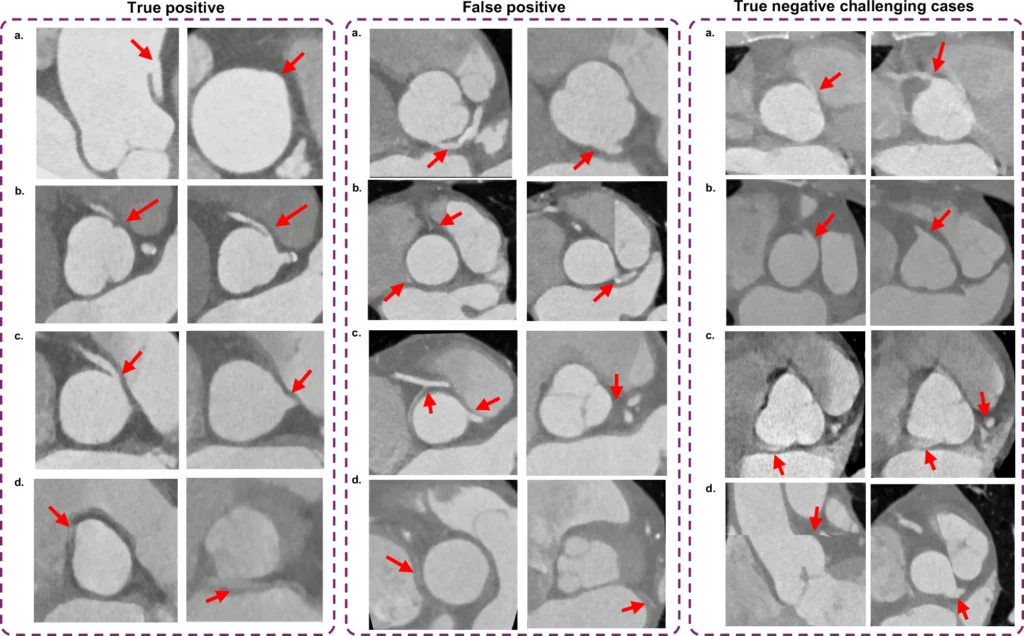
True positives: a) High take-off of the right coronary artery (R-AAOCA) with low-risk anatomy. b, c) Right coronary artery originating from the left coronary sinus (R-AAOCA) with high-risk anatomy. d Circumflex arteries originating from the right coronary sinus (L-AAOCA, left circumflex) with low-risk anatomy. False positives: a) Left coronary artery originating within the left coronary sinus but very close to the non-coronary sinus (b) Appearance of a very thin coronary artery (possible conus artery) mimicking an R-AAOCA and possible contrast agent artifact mimicking L-AAOCA (left circumflex), c) Very thin and short possible conus artery from the right coronary artery mimicking a left circumflex anomaly with immediate disappearance, d) Resembling of a very faint coronary artery (possibly conus artery) resembling the left circumflex (L-AAOCA), however, there was a large left circumflex from the main stem present. True negative challenging cases: a, b) Motion artifact creating an R-AAOCA-like anomaly, c) Motion artifact generating an L-AAOCA-like (left circumflex) anomaly, d) Motion (step artifact) artifact removing the connection of the left coronary artery to the left sinus.