Radiuma: A No-Code Graphical Workflow Generator for Reproducible Medical Image Analysis and Machine Learning

Software

Link to Source: github, arxiv

Authors: Mohammad Salmanpour, Mehrdad Oveisi, Isaac Shiri, Arman Rahmim

Summary: Radiuma is a freely available, zero-code platform that lets users build, execute, and share reproducible medical image analysis and machine learning workflows through a visual interface, without requiring programming expertise.

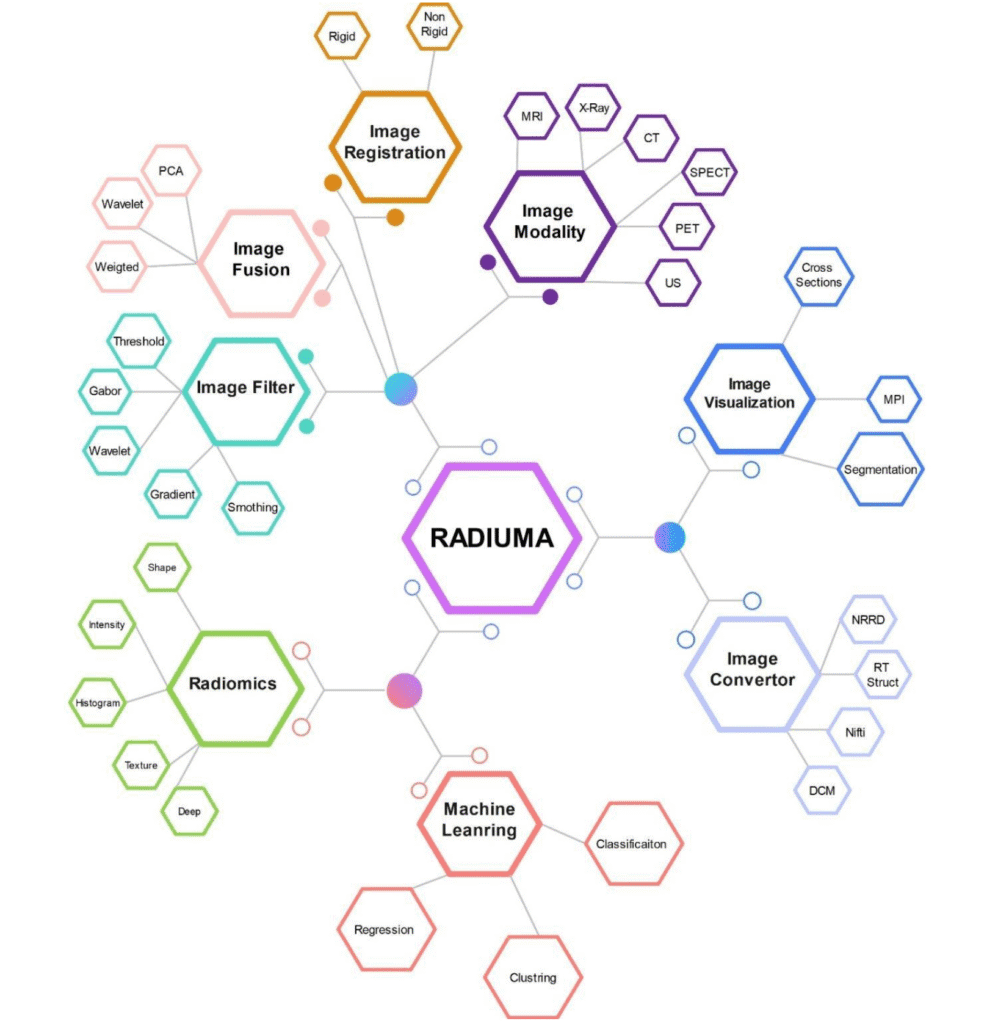
Radiuma is a freely available, zero-code modular platform for reproducible medical image analysis across multiple modalities and file formats. It unifies image reading, visualization, registration, fusion, processing, segmentation, radiomics feature extraction, and machine learning in a single environment. Users run modules independently or connect them through a visual workflow system, building custom, executable, and shareable pipelines without programming expertise, promoting transparency, reusability, and consistency across collaborative radiomics and machine learning research.

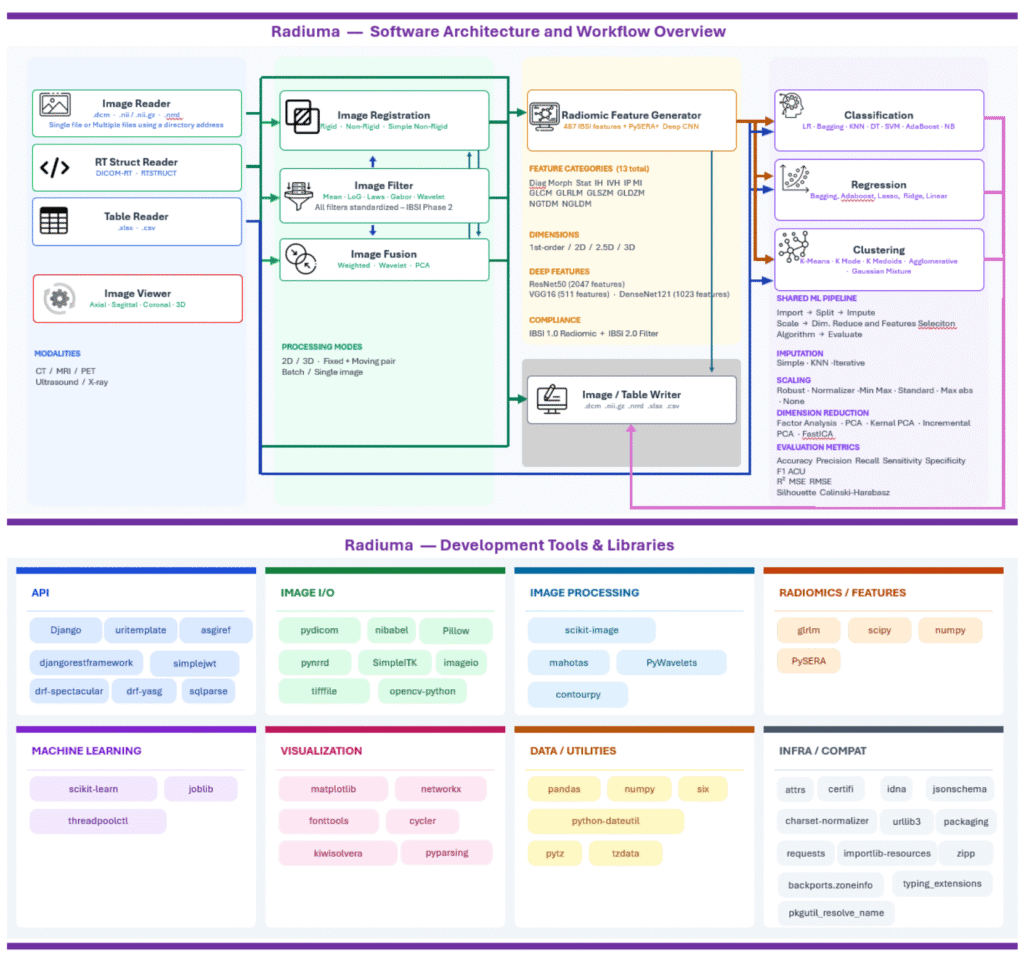
Overview of the Radiuma architecture. The upper panel shows the different modules of Radiuma and how they interact with each other within an end-to-end workflow, from image input through feature extraction and machine learning to result export. The lower panel shows the libraries and development tools used to build Radiuma.

Medical image computing software is essential for identifying imaging biomarkers that can support diagnosis, prognosis, treatment planning, and clinical research. However, the lack of standardized, user-friendly, and reproducible software environments has limited the broader adoption of advanced medical image analysis workflows. We present Radiuma, a freely available modular platform designed to support reliable and reproducible medical image analysis across multiple modalities and file formats. Radiuma integrates image reading, visualization, registration, fusion, processing, segmentation, radiomics feature extraction, and machine learning modules for classification, regression, and clustering. Its modular design allows users to execute each component independently or connect modules through a visual workflow system, where the output of one step can be graphically passed to the next. This enables the creation of custom, executable, and reproducible multi-step pipelines without requiring extensive programming expertise. Results from each module can be inspected directly in the visualization window, providing immediate feedback on processing quality and workflow accuracy. Radiuma also supports saving and sharing customized workflows, promoting transparency, reusability, and consistency across collaborative studies. By combining flexibility, usability, and standardized analysis tools, Radiuma provides a practical environment for radiomics and machine learning research in clinical and translational settings. The platform is designed to be accessible to users with diverse expertise, including radiologists, physicists, clinicians, and data scientists.
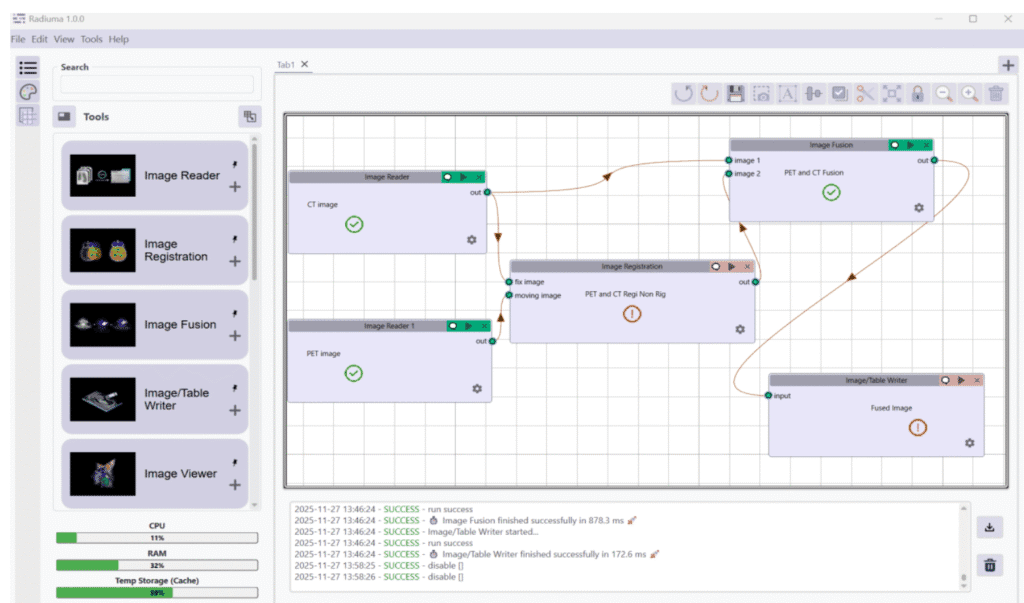
Radiuma interface demonstrating the node-based workflow editor and tab-based multi-workflow management, with multiple analysis modules connected into a complete medical image processing and radiomics pipeline.
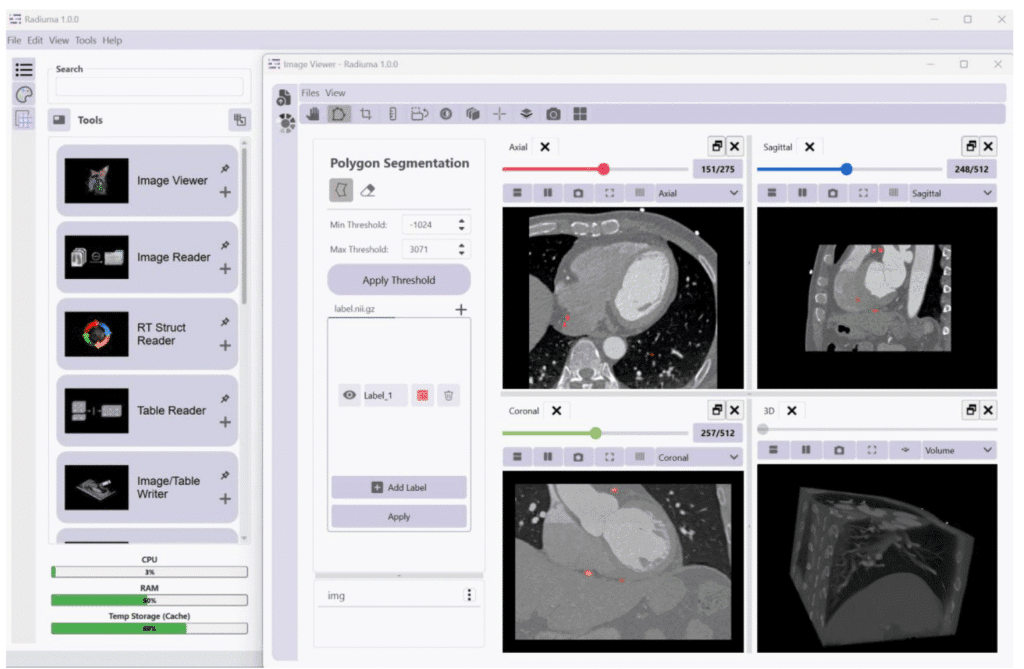
Radiuma Image Viewer demonstrating multi-planar and 3D views of medical imaging data with segmentation overlays. The viewer supports axial, sagittal, coronal, and volumetric renderings, along with tools for contrast adjustment, filtering, measurement, cropping, and segmentation editing.