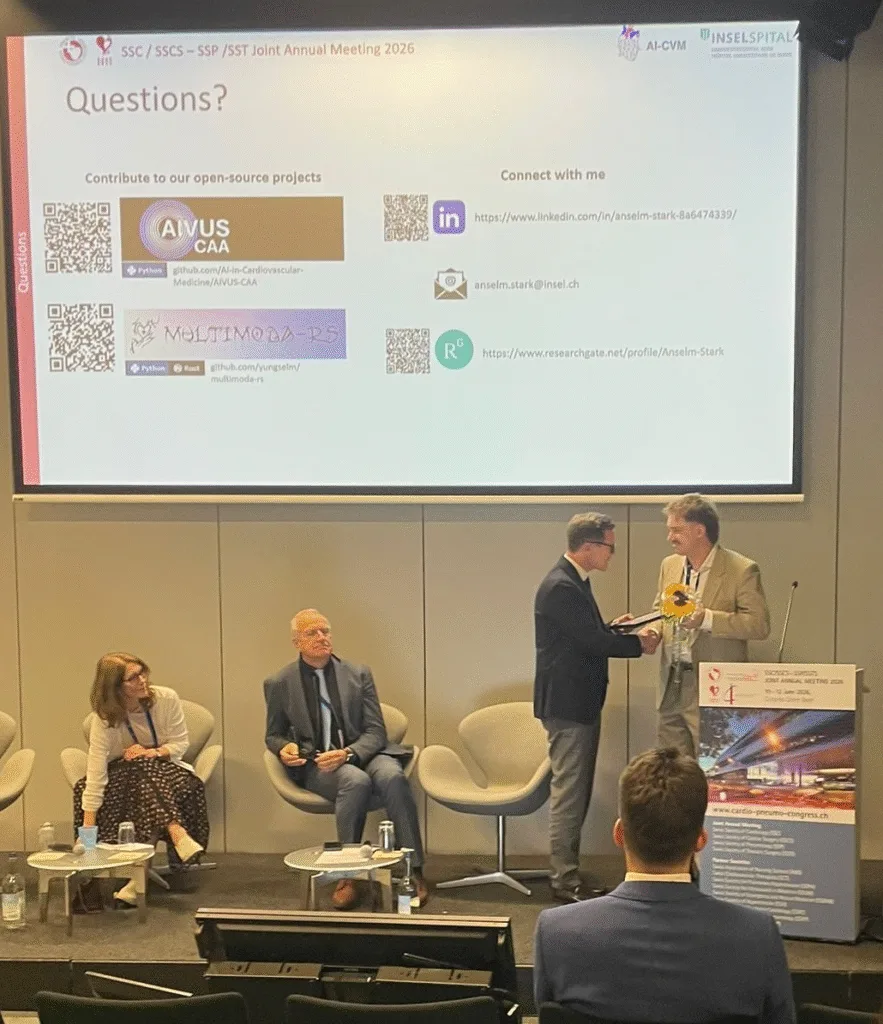
Anselm Stark, MD, PhD,
was awarded the Otto Hess Trainee Award 2026 by the Swiss Society of Cardiology, presented on 11 June 2026, for his doctoral thesis “Diagnosing Hemodynamic Relevance in Anomalous Aortic Origin of a Coronary Artery: A Combined Clinical and Engineering Framework”. The award honors young cardiologists for outstanding work and is endowed with CHF 5’000.
His thesis tackles one clinical problem from two angles: how to tell which patients with an anomalous aortic origin of a coronary artery (AAOCA), a congenital condition that can cause sudden cardiac death, actually have a dangerous restriction of coronary blood flow. AAOCA is increasingly found by chance in middle-aged adults undergoing CT angiography, yet confirming whether a given anomaly is hemodynamically relevant still depends on an invasive, uncomfortable reference test (fractional flow reserve under dobutamine-, atropine- and volume stress, FFRdobutamine) available at only a few specialized centers.
First, in a prospective cohort, Dr. Stark tested whether more accessible tests could predict the FFRdobutamine result. Each captured only half the picture. Among non-invasive tests, a minimal lumen area above 5.6 mm² on CT angiography was sensitive but not specific and could rule out relevance in half of the non-relevant cases, while a perfusion deficit on nuclear imaging was specific but not sensitive and could rule in relevance in one third of patients with hemodynamic relevance. Simpler invasive measures showed the same split: resting intravascular ultrasound (IVUS) reliably excluded relevance in half of the non-relevant patients, and adenosine-based pressure measurement (FFRadenosine) reliably confirmed it in one third of patients, but neither did both. Combining tests could confidently triage only about half of patients, leaving the rest dependent on the invasive reference. These findings were published in Circulation, JAMA Cardiology, and JACC: Advances (1, 2, 3).
Because no affordable test or combination fully closed the gap, Dr. Stark turned to computational fluid dynamics (CFD), which simulates coronary blood flow without any invasive procedure. CFD’s accuracy, however, is highly reliant on the input geometry, and an AAOCA stenosis is dynamic, changing shape across the cardiac cycle and from rest to stress, so its output must be validated against more than a single static snapshot. He built two open-source tools to solve both problems. AIVUS-CAA automatically segments IVUS images and pinpoints end-systole and end-diastole (4), while multimodars fuses that data with CT angiography into 3D reconstructions (5). Together they supply the high-fidelity geometries, across different hemodynamic states and cardiac phases, that CFD needs both as input and for validating its output.
By bridging clinical research and biomedical engineering, Dr. Stark’s thesis lays the groundwork for making accurate AAOCA assessment more accessible and, ultimately, scalable beyond specialized centers.
1. Stark AW, Matthey-de-l’Endroit RL, Ferroni A, Kakizaki R, Bigler MR, Biccirè FG, Ueki Y, Haeberlin A, Siepe M, Shiri I, Windecker S, Räber L, Gräni C. Coronary CT Anatomy-Based Prediction of Invasively Assessed Hemodynamic Significance in Middle-Aged Patients With Right Coronary Artery Anomaly: The NARCO Study. Circulation. 2025 Feb 25;151(8):578-580. doi: 10.1161/CIRCULATIONAHA.124.
2. Bigler MR, Stark AW, Caobelli F, Rominger A, Kakizaki R, Biccirè FG, Al-Sabri SMA, Shiri I, Siepe M, Windecker S, Räber L, Gräni C. Noninvasive Anatomical and Functional Imaging for Hemodynamic Relevance in Right Coronary Artery Anomalies. JAMA Cardiol. 2025 Oct 1;10(10):1055-1060. doi: 10.1001/jamacardio.2025.2993. PMID: 40928770; PMCID: PMC12423952.
3. Stark AW, Ferroni A, Mathey-de-l’Endroit RL, Kakizaki R, Bigler MR, Biccirè FG, Ilic M, Shiri I, Haeberlin A, Siepe M, Windecker S, Räber L, Gräni C. Invasive Right Anomalous Coronary Arteries Assessment: Intravascular Ultrasound and Adenosine vs Dobutamine Fractional Flow Reserve. JACC Adv. 2026 Feb;5(2):102526. doi: 10.1016/j.jacadv.2025.102526. Epub 2026 Jan 24. PMID: 41581388; PMCID: PMC12860356.
4. Stark AW, Mohammadi Kazaj P, Balzer S, Ilic M, Bergamin M, Kakizaki R, Giannopoulos A, Haeberlin A, Räber L, Shiri I, Gräni C. Automated intravascular ultrasound image processing and quantification of coronary artery anomalies: The AIVUS-CAA software. Comput Methods Programs Biomed. 2025 Dec;272:109065. doi: 10.1016/j.cmpb.2025.109065. Epub 2025 Sep 11. PMID: 40972478.
5. Stark et al., Marc, I., Mokhtari, A., Mohammadi Kazaj, P., Gräni, C. & Shiri, I. (2026). multimodars: A Rust-powered toolkit for multi-modality cardiac image fusion and registration. Journal of Open Source Software, 11(121), 10131, https://doi.org/10.21105/joss.